¶ Introduction
It shows that user experience is part of the “problem space” and also part of the “solution space”. This is often confusing for people who are unfamiliar with user experience. It is important to understand that user-experience research draws on information from the business model and provides user insights to user-experience design, which then iterates over possible solutions, tests these solutions with users, and provides the best possible solution design to the development.
¶ UX Maturity Model (based on Team Stages)
The UX Maturity Model is designed to help organizations assess and improve their user experience (UX) capabilities by focusing on the composition and development of their UX teams. Unlike traditional maturity models that use abstract levels, this model is grounded in the practical stages of building a UX team, making it more relatable and actionable.
This model recognizes that the effectiveness of UX practices is directly tied to the skills and roles within the team. By mapping out the evolution of a UX team from a single designer to a fully integrated, strategic unit, organizations can identify their current stage and plan for future growth. Each stage in the model outlines the team composition, their capabilities, and the corresponding maturity level, providing a clear path for enhancing UX competencies.
¶ This model describes the evolution of UX capabilities in projects:
- Initial UX Support:
- Team Composition: Single UX Designer
- Capabilities:
- Conducts basic user interviews
- Creates prototypes
- Provides basic UX design support
- Basic UX Research:
- Team Composition:
- UX Designer
- Junior UX Researcher
- Capabilities:
- conducts more in-depth user research
- creates detailed prototypes
- begins to implement user testing
- Team Composition:
- Established UX Research:
- Team Composition:
- UX Designer
- UX Researcher
- Capabilities:
- conducts comprehensive user research
- creates high-fidelity prototypes
- implements regular user testing
- Team Composition:
- Integrated Design:
- Team Composition:
- UX Designer
- UX Researcher
- UI Designer
- Capabilities:
- integrates visual design with UX
- conducts usability testing
- begins to create design systems
- Team Composition:
- Advanced Design Integration:
- Team Composition:
- UX Designer
- UX Researcher
- UI Designer
- UX Writer
- Capabilities:
- incorporates content strategy
- conducts advanced usability testing
- creates comprehensive design systems
- Team Composition:
- Technical UX Integration:
- Team Composition:
- UX Designer
- UX Researcher
- UI Designer
- UX Writer
- UX Engineer
- Capabilities:
- implements technical UX solutions
- conducts A/B testing
- optimizes user flows
- Team Composition:
- Strategic UX Leadership:
- Team Composition: Full UX Team
- Capabilities:
- leads strategic UX initiatives
- conducts continuous user research
- drives UX innovation across the organization
¶ Describe UX Roles:
-
UX Designer: Focuses on the overall experience and usability of a product. Their primary goal is to ensure that the product is functional, easy to use, and meets the needs of the users.
-
UI Designer: Focuses on the visual and interactive elements of a product’s interface. Their primary goal is to create aesthetically pleasing and intuitive designs that enhance the user’s visual experience.
-
UX Researcher: Specializes in understanding user behavior, needs, and preferences. They design and conduct studies, interviews, surveys, and usability tests to gather insights that inform the design process. Their primary goal is to provide actionable insights to the design and product teams.
¶ Application in Agile Sprints
¶ Introduction
This section demonstrates how the UX Process can be applied within the context of a two-week agile development sprint. It illustrates how the various components of the model can be effectively integrated into a fast-paced, iterative development process.
Breaking down work into iterations and phases will help you manage complexity and structure your design efforts more effectively.
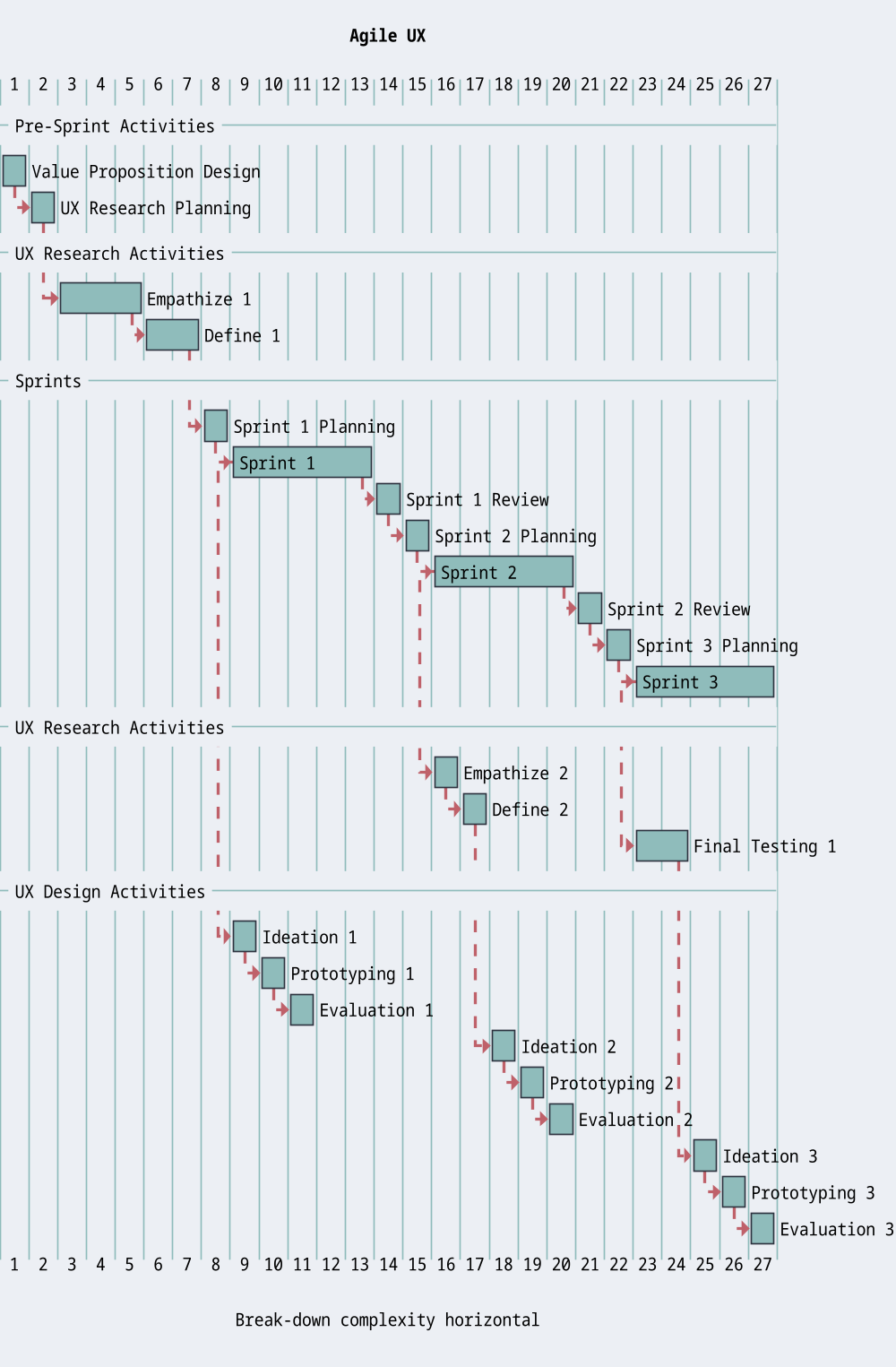
¶ Pre-Sprint: Initial Value Proposition and Research Planning
-
Initial Value Proposition (Product Owner’s Responsibility):
- Define the .
- Articulate key business goals.
- Identify target audience/users.
- Outline any known market opportunities or challenges.
-
Research Planning (UX Expert, informed by Value Proposition):
- Review the Product Owner’s value proposition.
- Identify areas that require user validation or deeper understanding.
- Plan user research activities to explore the target audience’s needs, behaviors, and context.
- Define research questions that will help validate or refine the business assumptions.
¶ Sprint-Based UX Process
The following chapter outlines how each element of the UX Process is incorporated into a two-week sprint, assuming the UX expert dedicates 20 hours per week to the project.
-
Week 1: Research, Analysis, and Initial Design (20 hours):
-
Contextual Interviews (5 hours):
- Involves conducting 4-5 user interviews.
- Enables quick gathering of user insights to inform the sprint.
-
Identify User Demands (5 hours):
- Involves creating user’s journey and drafting user stories for the sprint backlog.
- Translates user insights into actionable items for development.
-
Analysis and Sprint Planning (6 hours):
- Facilitates the integration of UX insights into the sprint goals and backlog.
- Includes participating in sprint planning and analyzing research data.
- Ensures UX insights are integrated into sprint goals.
-
Initial Design and Prototyping (4 hours):
- Encompasses Information Architecture.
- Includes sketching concepts, creating wireframes, and developing a basic prototype.
- Allows for quick visualization of design solutions.
-
-
Week 2: Detailed Design, Testing, and Implementation Support (20 hours):
-
Design Iteration (6 hours):
- Continues Information Architecture.
- Involves refining designs based on team feedback and creating detailed specifications.
-
Prototyping (4 hours):
- Extends the Design phases.
- Focuses on creating a comprehensive, high-fidelity clickable prototype.
- Provides a tangible product for testing and developer handoff.
-
Usability Testing (4 hours):
- Aligns with “Discount Usability Testing / User Feedback” in the process.
- Includes conducting tests with 3-4 users and analyzing results.
- Allows for rapid validation and iteration of designs.
-
Implementation Support and Sprint Wrap-up (6 hours):
- Bridges UX design with development implementation.
- Involves collaborating with developers and participating in sprint review.
- Ensures UX considerations are maintained during development and plans are made for subsequent sprints.
-
-
Benefits of This Approach:
- Ensures all key components of the UX Process are addressed within sprint constraints.
- Allows for iterative design and testing, aligning with agile principles.
- Maintains close collaboration between UX and development throughout the sprint.
- Provides flexibility to adapt to changing project needs and priorities.
-
Challenges and Considerations:
- Compressed timelines for each phase require efficient work and decision-making.
- Balance must be maintained between new design work and supporting ongoing development.
- Long-term UX strategy must be considered alongside sprint-specific goals.
- Continuous refinement of the process may be necessary to optimize UX integration in the agile environment.
- Potential for burnout of the UX expert due to the intense pace.
By applying the UX Process in this sprint-based structure, we can ensure that user experience considerations are fully integrated into their agile development process, leading to products that are both technically sound and user-centered.